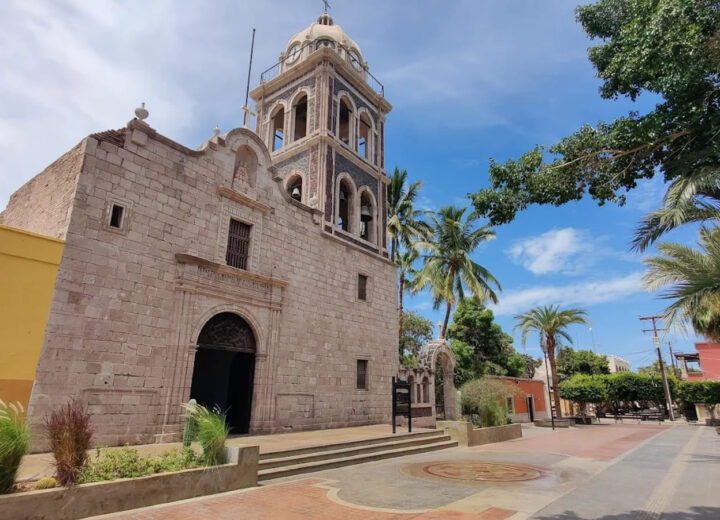

Twenty-two miles from Loreto, tucked into a valley in the Sierra de la Giganta, stands the mission of San Francisco Javier de Vigge-Biaundo: an eighteenth-century church of cut stone, nearly intact, in a village of a handful of residents. It is the essential land excursion from Loreto and, for many guests, the strongest memory of the trip.
How to get there
The road leaves the Transpeninsular Highway south of town and climbs a canyon to about 1,550 feet. It is paved and takes a little over an hour in an ordinary car, with tight curves and a couple of overlooks worth stopping at. There is no public transportation: you go in your own car, a rental or on a guided tour, which is the most comfortable option because the guide explains the history along the way. Book at the front desk or through experiences.
If you are driving in from elsewhere on the peninsula, check distances and times in how to get to Loreto.
What to see in the village
The church
It was built in the mid-eighteenth century with stone blocks hauled from the nearby hills, and it is considered the best preserved of the Baja California missions. The interior holds original gilded altarpieces and a coolness and silence that contrast with the heat of the valley. Enter respectfully: it is still a working church.
The mission olive tree
Behind the church is an orchard with olive trees planted by the missionaries. One of them has been there for more than three centuries and still bears fruit. Alongside the orchard runs the stone irrigation channel that still waters the village plots, engineering from the same period.
The valley and its orchards
Permanent water explains everything: it is why the missionaries chose this site and not another. Today the valley produces dates, grapes, figs and vegetables. You can walk among the plots and, with luck, buy date candy or cheese made right there.
Nearby petroglyphs and rock paintings
The sierra holds rock art from the Cochimi groups who preceded the mission. Some sites are a short distance from the road and require a local guide to visit.
How long the visit takes
Half a day is enough: an hour and a half of driving each way and about two hours in the village. The ideal is leaving early and getting back to the hotel for lunch; in summer, going up first thing makes all the difference, because the valley heats up by midday.
What to bring
- Water and something to eat: the village has very little on offer.
- Cash, in case you buy local product.
- Closed shoes if you plan to walk the orchard or the irrigation channel.
- A windbreaker in winter: the sierra runs several degrees cooler.
The mission route
Loreto was the starting point of the mission system of the Californias. The expeditions that founded San Javier in 1699, and in the following decades the rest of the chain to the north, all set out from here. Anyone wanting the long route can add Comondu, Mulege and San Ignacio, all north along the Transpeninsular. The origin story is in Loreto, capital of the Californias.
Where it fits in your itinerary
It works well as a counterweight to a day at sea: a morning in the sierra after a day in the islands changes the rhythm of the trip entirely. With four nights, the natural split is two days on the water, one in the sierra and one with no plan. More ideas in things to do in Loreto, and for the rest afterward, the beach club and the wellness area at the hotel.
The drive, step by step
The climb is part of the visit. The first few miles cross the plain among cardon cactus, then the road enters the canyon and starts gaining height between walls of volcanic rock. There are two or three natural overlooks worth a stop: from up there you see the bay with the islands behind it and, on the other side, the spine of the sierra.
Halfway up, a historic ranch with its orchard appears and, farther on, the first sign of the valley: patches of green in a dry landscape. That contrast explains why the missionaries chose this place. If you go with a guide, a stop at the nearby petroglyphs adds a well-spent half hour.
Frequently asked questions
Can you get to San Javier in a regular car?
Yes. The road is paved the whole way. It just calls for taking the curves calmly.
How long does it take from Loreto to San Javier?
An hour to an hour and fifteen, not counting stops at the overlooks.
Is there an admission fee?
The church is open to visitors. A voluntary contribution toward its upkeep is customary.
Is there anywhere to eat in the village?
There are a couple of family-run kitchens with short hours. Do not count on it; bring water and fruit.
When is the village festival?
The patron saint celebration is December 3 and it brings in ranchers from across the sierra. It is the liveliest date of the year and also the busiest.